

Every summer night, something hauls out of the Gulf and up past the tide line.
Three species of sea turtle nest on Alabama’s beaches, and one of them does nearly all of it. The loggerhead — Caretta caretta — is the big reddish-brown turtle with the blunt head, and in a typical recent season she accounts for almost every nest laid on this coast. Kemp’s ridleys turn up in ones and twos. A green turtle is news.
The numbers are smaller than people expect. Alabama logs roughly 70 to 150 nests in a season — 96 in 2025, 78 in 2024, 143 in 2023 — against a record 237 back in 2016. Spread across the whole coastline, that is not many turtles. It is enough that a walk at sunrise in July can put you on a fresh track, and few enough that every nest gets counted.
The season
Nesting season runs May 1 through October 31. A female comes ashore in the dark, crawls up past the wet sand, digs a chamber, lays somewhere around a hundred and ten eggs, covers it, and goes back to the water — leaving a track like something dragged a tire up the beach. Incubation runs roughly 55 to 70 days, so the nests laid in May start hatching around the time the ones laid in July are still cooking.
Hatchlings emerge at night and orient themselves toward the brightest, lowest horizon, which for the whole history of the species has been the open Gulf reflecting the sky. That single instinct is why the rules below exist.
Share the Beach
The volunteers who find and mark those nests belong to Share the Beach, a program started in 2001 by the U.S. Fish & Wildlife Service and run since 2018 by the Alabama Coastal Foundation. They walk the beach at dawn from May through August looking for tracks, stake and screen what they find, sit with nests near hatching, and spend the rest of their time talking people into turning lights off. Their patrols cover every mile of Alabama’s beachfront.
If you find a nest, a nesting turtle, or a turtle in trouble, the number is the Alabama Sea Turtle Hotline, 1-866-SEA-TURTLE (1-866-732-8878). Do not touch anything; just call.
What visitors are actually asked to do
Three habits cover most of it, and none of them cost you anything.
Leave the beach flat. Fill in every hole you dig and knock down the sandcastle before you go. A hatchling that drops into a hole it cannot climb out of does not get a second try, and a nesting female can be turned back the same way. Both cities cap digging at twelve inches.
Take your gear with you. Chairs, tents and coolers left on the sand block the crawl. Gulf Shores clears the public beach after 8 p.m.; Orange Beach clears it one hour after sunset, and what gets collected is thrown away, not stored. The deadlines are different — check which beach you are on.
Kill the lights. Orange Beach adopted a wildlife-friendly lighting ordinance in 2025 covering the beachfront overlay: long-wavelength amber fixtures, shielded and aimed down, nothing at all on the dune walkovers, and a 9 p.m. cutoff during nesting season for televisions visible from the beach, tiki torches, lanterns and phone flashlights. If you are renting, the fixtures are already someone else’s problem — the part that is yours is the balcony light, the curtain, and the flashlight.
If you do come across a turtle on the beach, stay at least thirty feet back, stay low, stay quiet, and put the phone away. No flash, no video light. The Orange Beach Welcome Center hands out red stickers to cover a phone’s flashlight, which tells you how often this comes up.
Where the design came from
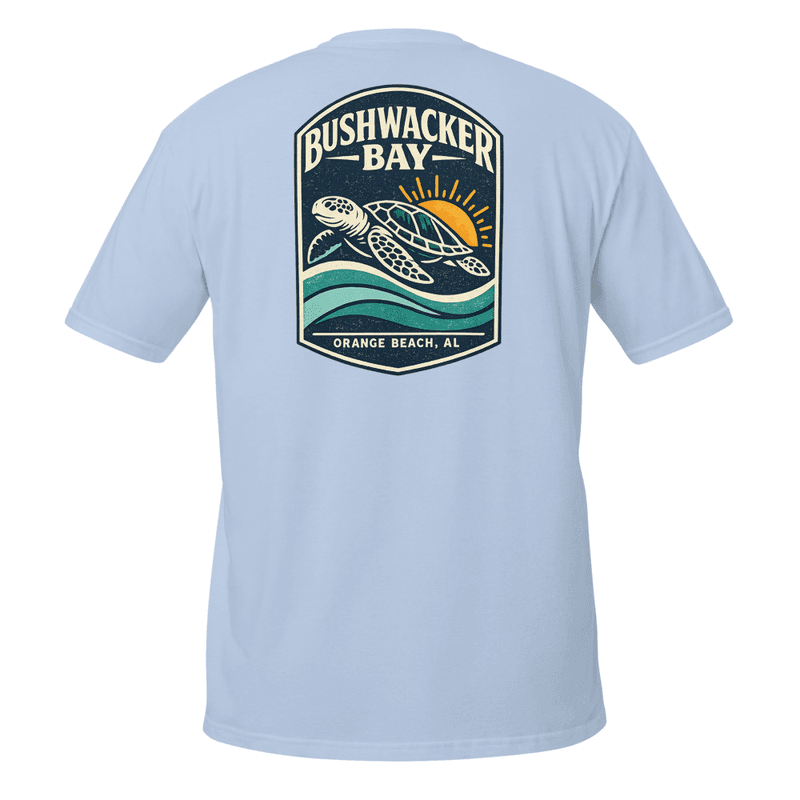
Our Loggerhead print draws her the way the old naturalist crests did — the turtle over layered swells in deep navy and sea green, sun coming up behind her, Orange Beach on the banner underneath. Not a cartoon turtle in sunglasses. A specific animal that has been using this beach far longer than the condos have, drawn like it matters.
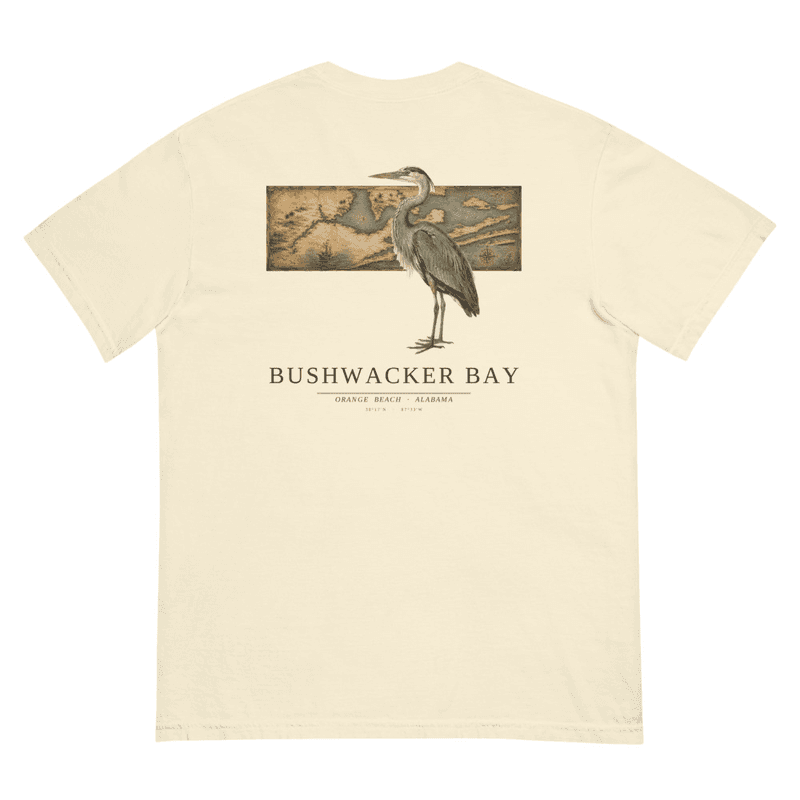
It sits alongside the Great Blue Heron for the same reason: this coast has real wildlife worth drawing carefully, and most beach merch settles for less.